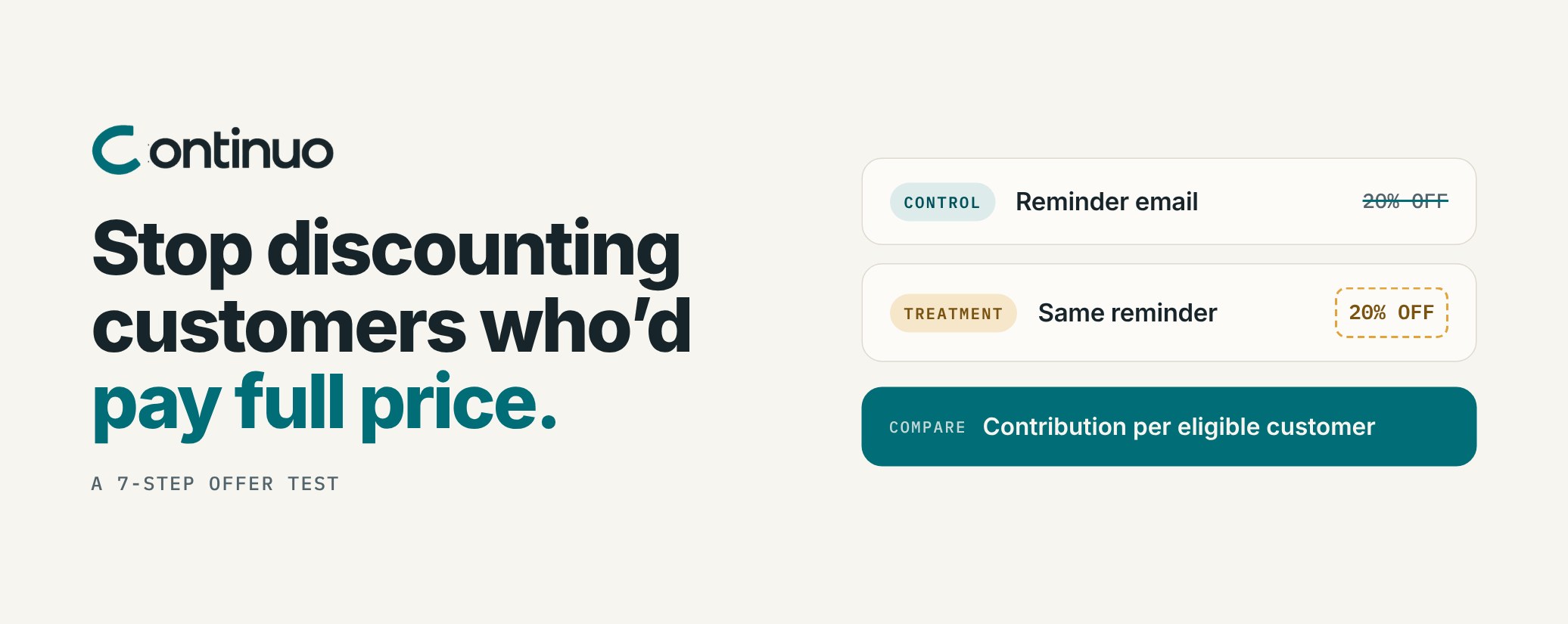
Some customers using your 15% or 20% code would have bought again anyway. The code didn’t win those sales. It just reduced your margin.
Here’s a step-by-step playbook to identify where discounts may be unnecessary and test a better approach in Shopify and Klaviyo.
Step 1Measure your discount exposure
Analyse second and subsequent orders placed in the last 90 days. Exclude each customer’s first order, using earlier purchase history where necessary.
Count each order once. Include automatic discounts as well as discount codes.
Calculate:
- The percentage of repeat orders purchased with a discount.
- The total discount value on those orders.
This measures discount usage and cost. It does not yet establish whether those discounts generated incremental sales.
Step 2Audit the offers in your flows
Review replenishment, win-back, post-purchase and abandoned cart.
For each flow, record:
- The discount amount or incentive.
- The message containing the offer and its timing.
- The segment eligible to receive it.
For example:
- 20% off
- replenishment email 1
- all replenishment-eligible customers
Are you offering a discount in the first reminder? Are frequent buyers receiving the same offers as lapsed customers?
Step 3Select a segment to test
Start with replenishment-eligible customers showing purchase intent.
For example:
- Placed an order at least twice in the last 120 days.
- Viewed the relevant product in the last 14 days.
- Reached their expected replenishment window.
Adjust these criteria to your product and purchase cycle.
These signals suggest purchase intent. They do not prove that customers will reorder without a discount.
Step 4Run a controlled offer test
Randomly assign customers in that segment to two groups:
Replenishment reminder without a discount.
The same reminder with your current discount.
Keep the send timing, product recommendation and other messaging consistent. Prevent overlapping promotions from giving the control group the discount elsewhere.
Keep each customer in their assigned group throughout the test.
Set the measurement window and sample-size requirement before launch. Allow every customer the same follow-up period, and don’t declare a winner from a handful of orders.
You can set this up this week. A reliable result may take longer.
This tests the discount’s incremental value. Testing the flow itself requires a separate no-message holdout.
Step 5Compare contribution per eligible customer
For each group:
Include non-buyers in the denominator.
Calculate contribution after discounts, refunds, product costs, fulfilment, brand-paid shipping, payment fees and incentive costs. Contribution is not net profit.
Then ask:
Did the discount increase contribution per eligible customer compared with the no-discount control?
A higher conversion rate alone does not answer that question.
Step 6Use the result to change the offer
- If the no-discount control generates reliably higher contribution per eligible customer, reduce discounting for the tested segment.
- If the discount performs better, retain it for that segment and test whether a smaller discount can improve contribution further.
- If the result is inconclusive, don’t declare a winner.
Apply the finding to the segment you tested. Don’t assume it holds across your entire customer base.
Step 7Check whether the advantage holds over 90 days
Continue tracking customers in their original test groups. Measure the 90 days following each customer’s assignment date.
- Contribution per test customer
- Total contribution from orders during those 90 days ÷ all customers assigned to the group.
- Repurchase rate
- Customers who place at least one order during those 90 days ÷ all customers assigned to the group.
- Full-price order share
- Orders purchased without a price discount during those 90 days ÷ all orders placed by the group during that period.
Define how subscription and bundle pricing count before reporting full-price share. Deduct gift costs from contribution even when the order has no price discount.
Does the initial contribution advantage hold over 90 days, or did the offer mainly bring purchases forward?
The test cannot identify every customer who would have paid full price. It can show which segments generate more contribution when you change the offer.
Not sure whether your replenishment discounts earn their cost?
Book a free 30-minute retention diagnosis call. We’ll review the figures you can share, identify where discounting deserves a closer look, and discuss whether a deeper audit makes sense.
Next in the series
They Tried to Buy Again. Something Stopped Them. Coming soon.