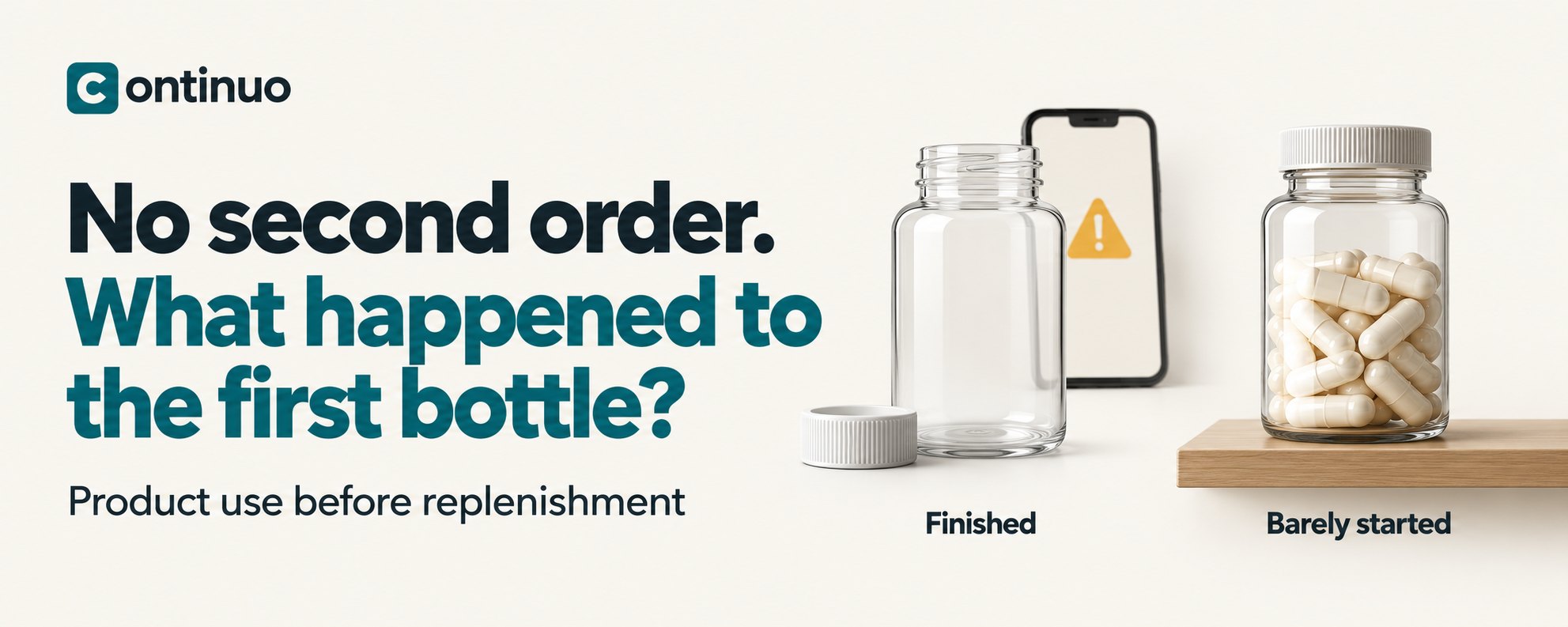
A customer buys a 30-serving supplement. Your system starts counting down to the next order.
The order arrives. The onboarding emails go out. A replenishment reminder follows.
Then nothing. No second purchase.
Before changing the reminder, there is a question worth asking: what happened to the product they already bought?
Two customers with the same missing order
Imagine two customers buying the same supplement. These are illustrative examples, not client cases.
Customer A uses it consistently, likes the experience and finishes the bottle. They return to buy again, but a payment error stops the order.
Customer B uses it a few times, never settles into a routine and leaves it in the cupboard. Six weeks later, most of the bottle is still there.
Your store records the same outcome: neither customer bought again. But the reasons are different.
The first customer needs help completing a purchase. For the second, you need to understand why use stopped before deciding what help is appropriate. Another “Time to restock” email assumes a need you have not established.
The journey between buying and buying again
A replenishment flow can make the journey look simple: purchase, wait, remind, reorder. The customer still has to receive the product, start using it, find a place for it in their life and decide whether the experience is worth continuing.
Replenishment assumes depletion. Depletion assumes use. Use assumes the product became part of the customer’s life.
That is why a weak second-order rate can be a reason to investigate product use, even when the email sequence is working as designed.
The path to the second order
Use six questions to investigate what happened. They organise the journey; they do not mean every customer follows a fixed sequence or waits until the bottle is empty to reorder.
- Received
- Started
- Continued
- Experienced
- Depleted
- Reordered
Received
Did the customer actually get the product? A placed order is not a completed delivery. Check delivery problems and unresolved support conversations before assuming the customer has begun using it.
Started
Did they begin using it? The parcel can arrive while the bottle stays unopened. The customer may be unsure how to start, have an unanswered question or simply put it aside. A delivery notification cannot distinguish those situations.
Continued
Did use become consistent? Starting once does not tell you whether the product fitted into a routine. Ask what got in the way rather than assuming the customer forgot. Confusion, inconvenience or an unwanted experience may call for very different responses.
Experienced
Did the experience match expectations? Look at what the customer expected from the purchase and what they actually experienced. Expectations may have formed in the ad, long before your first email. Satisfaction and perceived benefit matter to the buying decision, but neither establishes clinical efficacy.
Depleted
Has replenishment become relevant? A customer who still has most of the bottle may have no reason to buy more. Purchase quantity, when use began and how consistently it continued all affect when another order makes sense.
Reordered
Could they complete another purchase? If they wanted more and tried to buy, inspect the product page, availability, shipping, checkout and payment experience. The problem may be the route back to purchase.
A 30-day supply is not a customer behaviour
Thirty servings tells you how much product was sold. It does not establish when the customer started or how often they used it. If use is inconsistent, “30-day supply” is packaging arithmetic, not necessarily a 30-day reorder cycle.
A fixed reminder can be a starting hypothesis. It should not become evidence that every customer is running out on the same day.
What your store cannot tell you
Order data can show that a second purchase has not happened. It usually cannot tell you whether the first bottle is empty, unopened or sitting half-used in a cupboard.
An email click may show interest. It does not prove that the product became part of a routine.
A useful check-in could ask: “Have you started using your order?” Then, where relevant: “How has the experience been?” or “What has made it difficult to continue?”
Combine voluntary responses with delivery records, support conversations, returns and purchase behaviour. Customer reports are imperfect, and people who respond may differ from those who do not. Use them to guide the investigation, not to fill every unknown with certainty.
From an unanswered question to a useful change
This is where Continuo’s diagnostic model becomes practical:
- Signal
- Standard
- Sequence
- Blind Spot
- Intervention
- Proof
Signal and Standard: second-order conversion looks weak. Compared with what? Use customers with comparable time since their first purchase and a window that makes sense for the product. A recent buyer has had less opportunity to reorder.
Sequence and Blind Spot: locate the first transition you cannot explain. Do you know the product arrived? Whether use began? Why it stopped? Identify what the order history cannot answer.
Intervention: choose a change that addresses the evidence. An unresolved delivery issue calls for delivery support. Confusion about getting started may call for clearer guidance. A payment failure calls for checkout investigation. A disappointing experience calls for understanding the complaint, not pressuring the customer to continue.
Proof: decide what improvement would look like before making the change. If the aim is to help customers get started, customer-reported use may be a useful early signal. Then check whether repeat purchase and customer value improve over a defined period, ideally against a comparable group. More clicks alone do not establish better retention.
Before your next replenishment email
Choose one product and map the six stages. Write down what you know at each stage and what you are only assuming.
Then identify the first unanswered question that could change what you do next.
For your supplement brand, the next useful retention action may begin with understanding the bottle already in your customer’s cupboard.
Before asking for the next order, understand what happened after the first.
Next in the series
They Tried to Buy Again. Something Stopped Them. Coming soon.